

Industrial AI doesn't start with the model. It starts with whether the data underneath it has context. A contextualized knowledge graph provides that context. An open, stable API makes it accessible to applications running across sites, and to the AI agents querying it. Get that foundation right, and everything built on top of it scales.
Where most industrial AI conversations go wrong
Most conversations about industrial AI start at the top: the agent, the insight it produces. This one starts a level below that, with the foundation the agent actually depends on.
Industrial data is diverse by nature: structured time-series data sitting alongside unstructured files, P&IDs, and imagery. Centralizing it in one place doesn't solve the deeper problem, because the same piece of equipment is often labeled differently depending on which system logged it. That mismatch is usually treated as a data harmonization or master data management problem, trying to fix the data itself rather than the relationships within it. A knowledge graph instead captures the meaningful relationships between records and persists them, so a pump, a file, and a work order can be linked even when their names don't match.
A knowledge graph built for industry
That kind of graph - one that links a pump to a work order to a file - is where most approaches stop. In an industrial setting, that's a starting point, not a finish line: knowing two records are related isn't enough if you're missing the broader context behind them. A knowledge graph built this way extracts the content from P&IDs, work orders, 3D models, and time series, and enriches the graph with it, so the relationship itself carries real information.
The diagram below shows how that plays out: the raw diversity of industrial data on one side, and the contextualized knowledge graph it feeds into on the other. A few of these layers - how that data gets viewed differently across roles, and how it's made accessible at scale - are worth unpacking further.
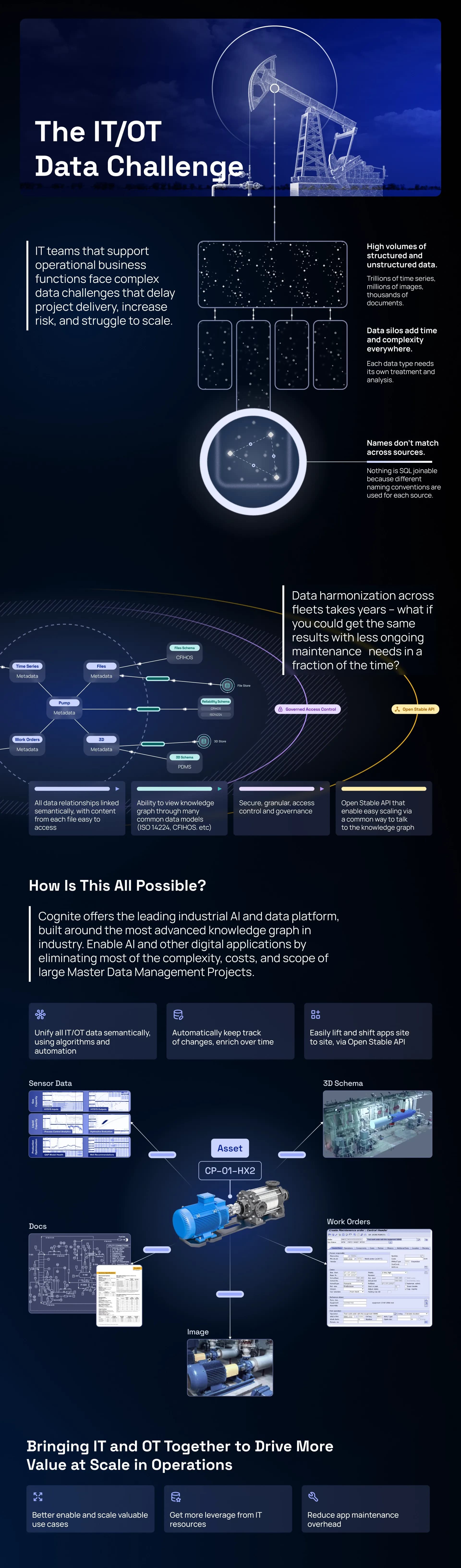
How Cognite structures industrial data to give AI both context and language
One source of truth, in the field or the office
On top of that contextualized graph, different roles can view the same data through the lens that matters to them, from a reliability engineer who might expect an ISO 14224 view, to an asset owner who might expect CFIHOS. Rather than duplicating the graph for each model, one graph supports multiple lenses. A separate layer of access control then governs who can see what across the whole system.
Why industrial AI applications don't scale across sites
Scaling an application across sites is a separate challenge from getting the data right in the first place. One example: a major energy company with 15 offshore assets audited its applications and found 140 built across those assets, all delivering real value, none considered redundant. But none of those 140 applications had ever been deployed beyond the single asset they were originally built for. It's a pattern common enough across the industry that it points to an architecture problem, not just a data one. One that leaves already tightly-resourced IT teams maintaining far more one-off applications than they should have to.
That's where an open stable API comes in. It gives every application and agent the same consistent way to talk to the knowledge graph, regardless of which site, line, or rig it's deployed on. Build an application once against that API, and it can run at another site without being rebuilt for that site's particular data setup.
Context meets language
That same API does more than let applications scale across sites, it's also what makes AI agents possible in the first place. Large language models rely on two things: context and language. For a language model, context normally comes built into the text it's trained on, but industrial data, like streams of time-series values, has neither: no language, and no context on its own.
The knowledge graph supplies the context. The open, stable API supplies the language, a consistent way to access that context. Together, they let an AI agent, including the ones behind Cognite Atlas AI, query and reason across industrial data in a deterministic way.
Where industrial AI actually starts
None of this starts with the AI. It starts with whether the data underneath it can actually support an agent asking a specific question and getting a reliable answer back, built from the ground up, not bolted on afterward.
If an agent asked your data a specific question tomorrow, would it get a reliable answer back?
Unpack this further in a short video - watch it here
Explore how Cognite Data Fusion® builds this foundation