

Should I “Google it” or “ask ChatGPT”?
Three years into the proliferation of LLMs, AI is undeniably changing how we, as consumers, interact with information. The unparalleled context provided by LLMs gives us answers to questions previously too complex for a Google search:
“What are the best SUVs with high safety ratings, good fuel efficiency, and low maintenance costs?”
Instead of having to compile this information from consumer reports and online reviews, ChatGPT does the heavy lifting and shares the rationale behind its recommendations. If the next step is to test-drive one of these vehicles, searching “Honda CR-Vs near me” on Google will return exact matches to the closest dealerships. How you search matters.
If you need to synthesize complex data or solve a multi-layered problem, ask ChatGPT. If you need a specific, isolated fact, Google it.
In the industrial world, this same distinction exists. Whether you are a process engineer troubleshooting a process disruption or a maintenance planner building a work package, the right search mode depends on your intent. To reduce the time to find actionable industrial information, Cognite is embracing multiple search modes, breaking away from the limitations of a one-size-fits-all approach. Search is a spectrum of intent, dictated by the use case, and must allow users to choose their own path. While many workflows begin with search, the most common needs for industrial users are exploration for complex questions and precision search with traversal for exact matches.
While the focus of this discussion is on using the right search for the given use cases, we should not overlook the precursor of breaking down the many data silos in industrial environments to unify all operations, engineering, and IT data into a robust industrial data foundation. To support both search modes, all results must be grounded and in context to ensure transparency and trustworthiness needed to turn search results into action. The Cognite industrial knowledge graph is the trusted data foundation powering search and all other workflows and applications for AI agents and industrial users.
Exploration for the complex questions
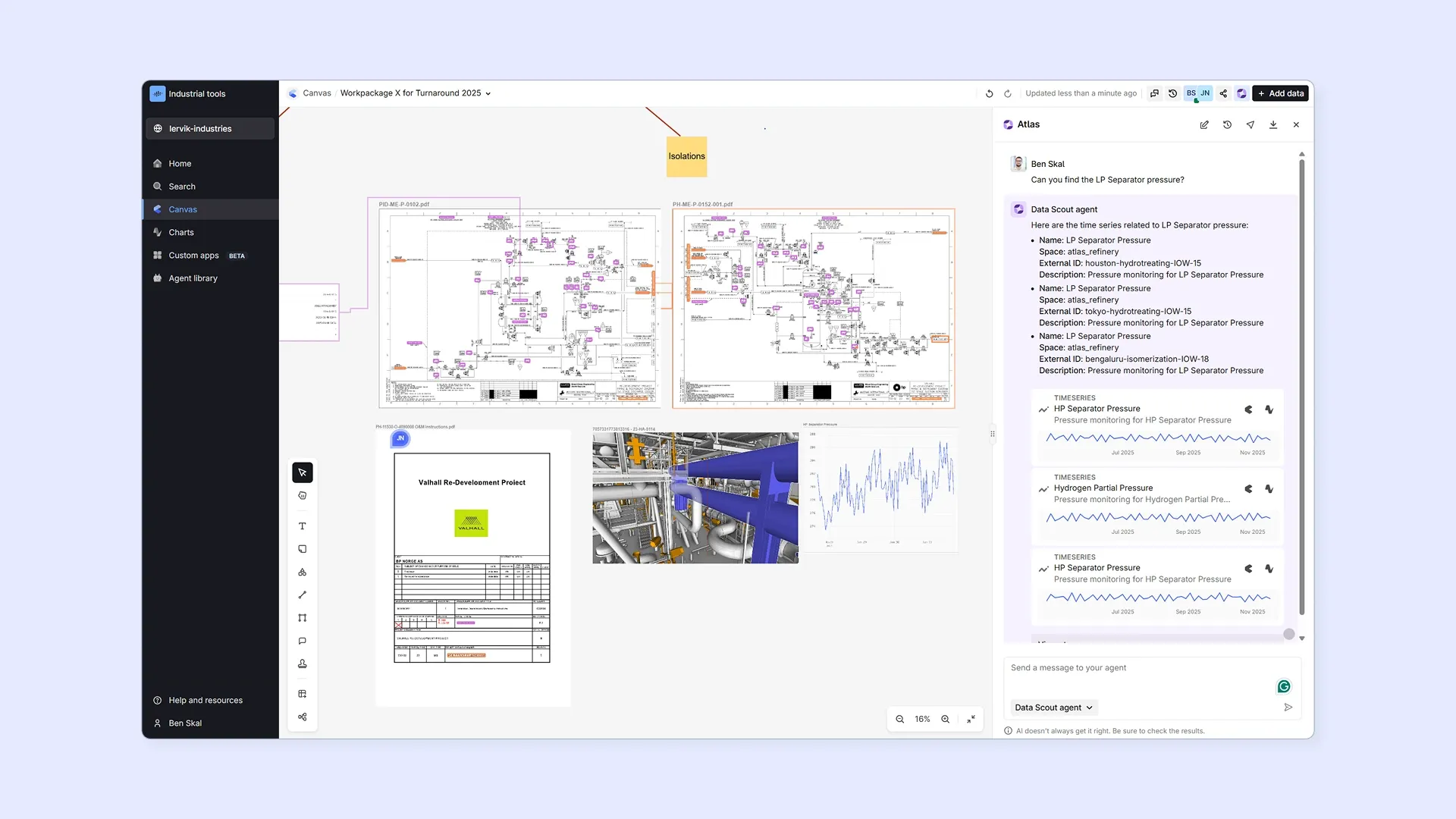
When a process engineer is performing a root cause analysis, they need to access relevant time series data, work orders, P&IDs, operations manuals, and more. This is the "Ask ChatGPT" moment of the plant floor. To perform a root cause analysis, you need a full picture of operational performance, so your search experience must surface all relevant information for analysis. Within the Cognite Industrial AI and Data platform, we solve this by pairing our Data Scout agent with the Industrial Canvas. This agentic search experience, again, powered by a robust industrial knowledge graph, pulls all relevant data into a free-form workspace. Through this workflow, customers like AkerBP have reduced their time to complete a root cause analysis from 6 weeks to 6 hours.
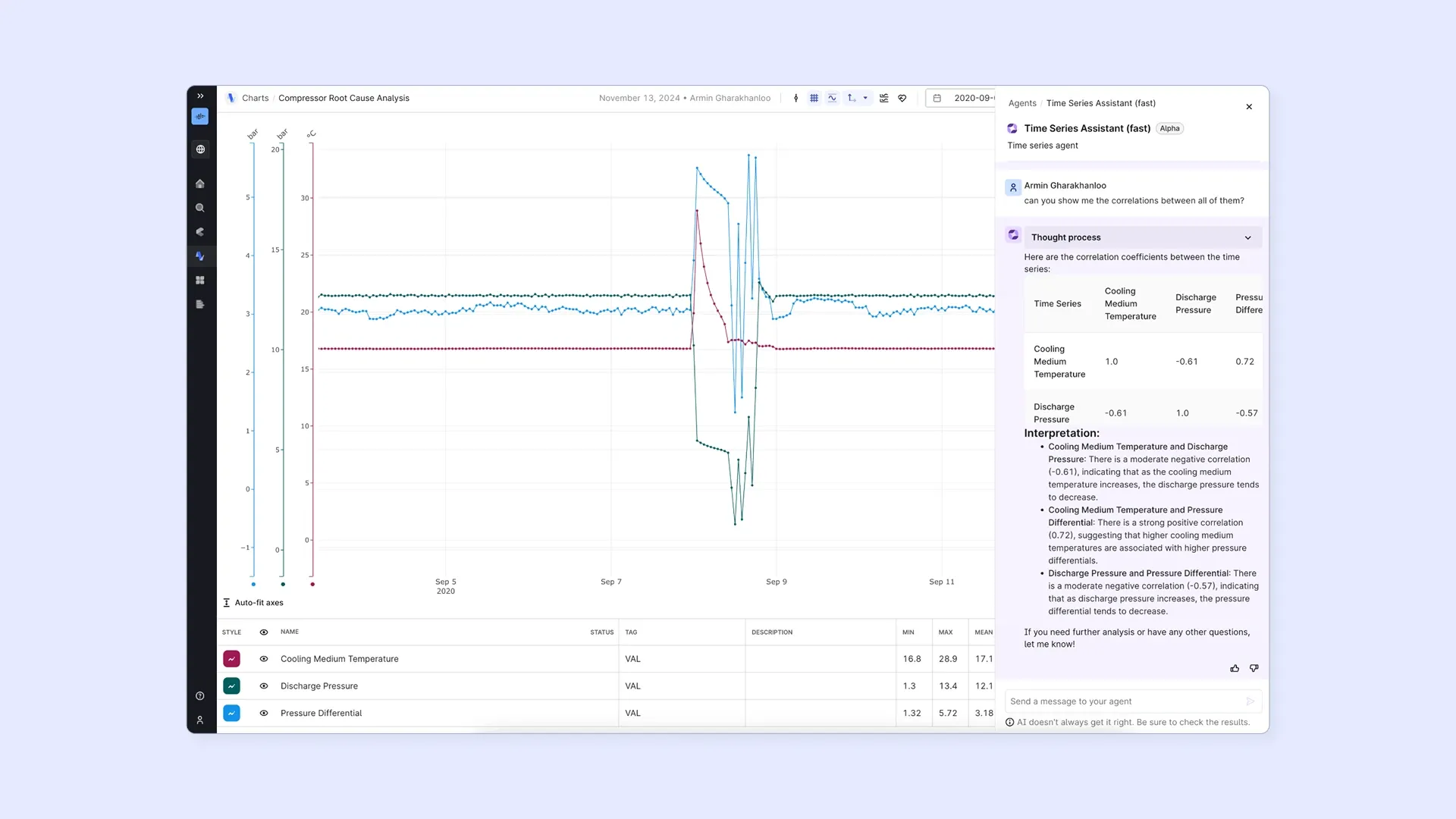
Another use case ideal for an LLM-powered search is a data scientist analyzing the performance of a process or piece of equipment. The data scientist needs all relevant time series data and events related to a specific process, and may not know all associated tag names. Using Cognite’s Time Series Trender agent and Cognite Charts, a no-code analytics application, a data scientist can easily plot and analyze all relevant time series. Additionally, this agent is equipped with the skills to perform calculations, further accelerating analysis.
These are just two examples of how AI agents can navigate an industrial knowledge graph to provide an exploratory view of relevant data. Scenarios extend across maintenance looking to see all work orders planned for a specific unit, operations needing to see summaries of their operations across rounds, maintenance logs, and operator reports, and many more. This search mode is ideal when context is critical, and driving the appropriate action requires information from several sources.
Precision Search with Traversal for the exact match
Precision search with traversal is designed for industrial users who need to quickly find a known starting point and gather additional information by traversing a known structure. Industrial organization have 1000’s of assets and P&IDs, 10’s of thousands time series tags and work orders, and 100’s of thousands of events and records. To save users time, the precision search must filter out unnecessary results and provide the optionality to explore information through a lens users can easily navigate.
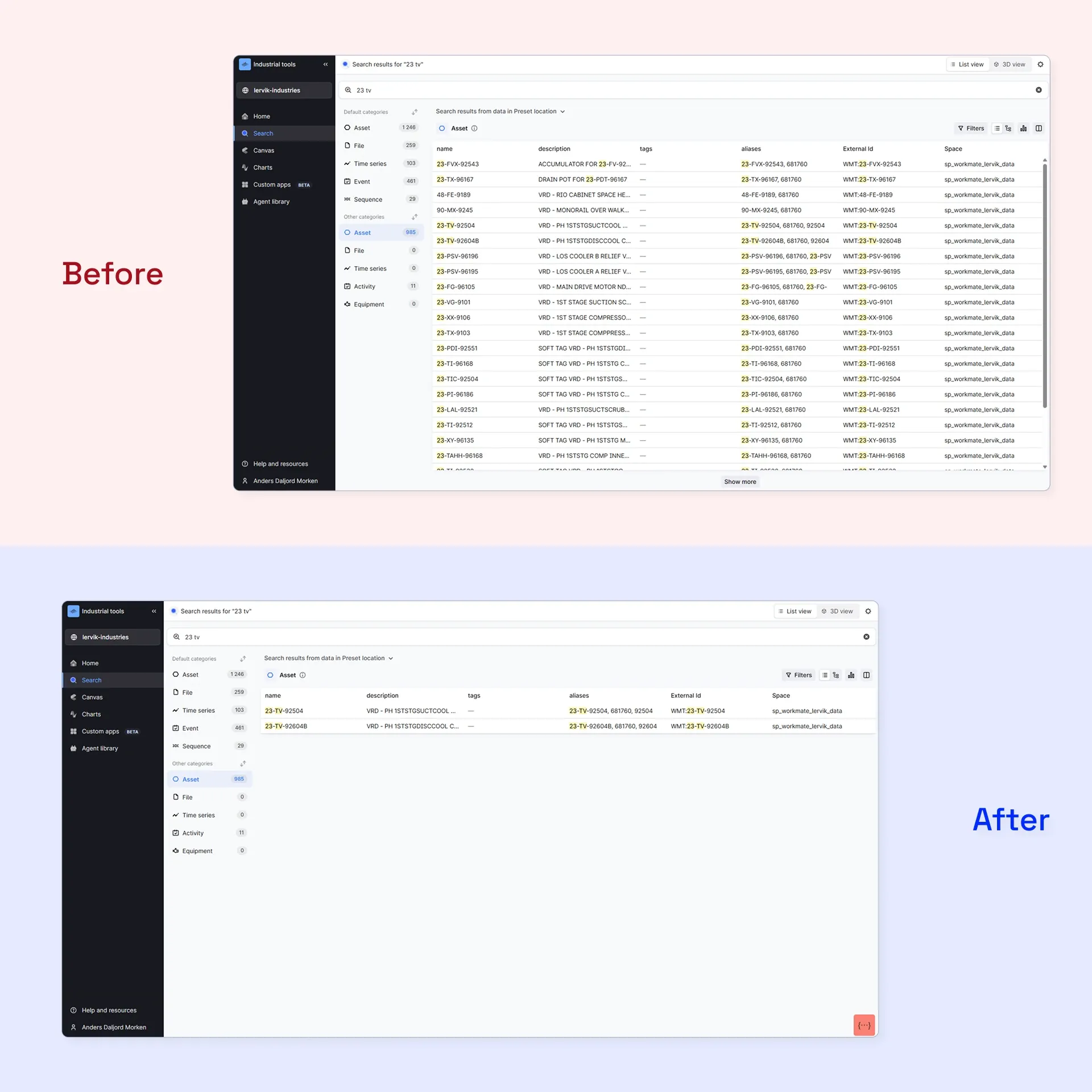
Cognite has fundamentally upgraded the core search experience to solve the "too many results" challenge common when navigating complex industrial data. By employing smarter parsing, Cognite’s Google-like search now logically breaks down queries using dashes, dots, or capitalization, ensuring that a search for "21-PT-10-19" targets that exact entity rather than diluting results with every "21" or "10" in the system. Flexible matching that recognizes "0059" and "59" as the same asset eliminates the friction of varied naming conventions. This precision search strengthens user trust, ensuring that when a maintenance engineer needs a specific standard operating procedure or work order, they find the needle in the haystack every time. This difference is already making an impact for our customers:
“It’s a night and day difference. The new search is much faster and eliminates the ‘fluff’ of noisy results. Because the engine now parses and separates terms, the user doesn’t need to be precise with the search. What we need is right at the top, and it’s making our operators’ lives easier.”
– Brett Green, Operator, Koch Ag & Energy Solutions
Once the precise information is found, users commonly need to traverse a pathway they already understand (similar to how you would search for a restaurant on Google Maps and navigate the map to see nearby shopping or entertainment):
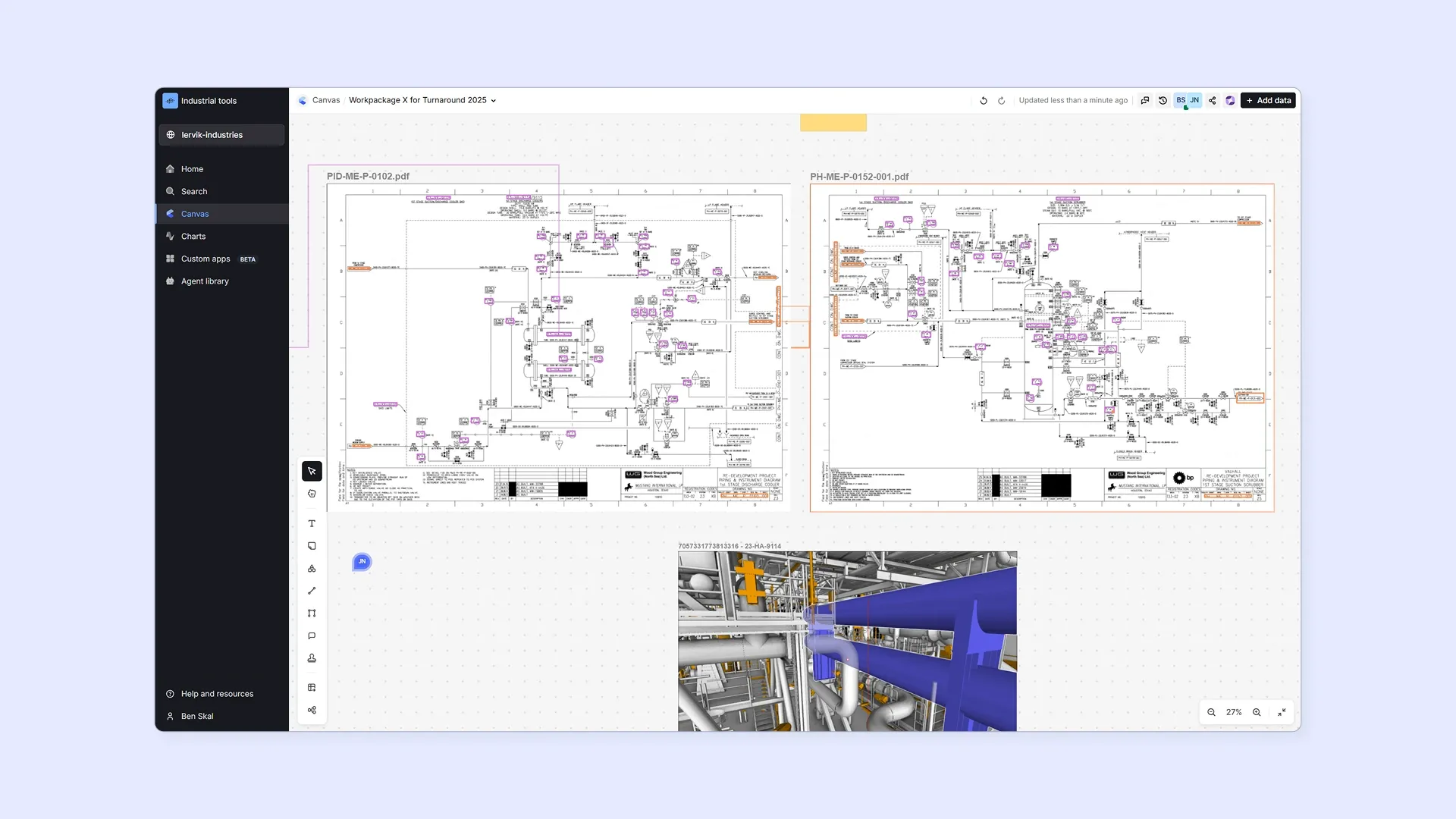
1. P&ID Tracing: Navigating "live" diagrams to see the status of equipment upstream and downstream of a process. Imagine a process engineer preparing an isolation plan for a specific work order scheduled for the upcoming week. The process engineer locates the upcoming work order and navigates the P&ID to determine the appropriate isolation plan. This search starts with a known point and requires context to understand what is upstream and downstream of the planned work, the operating plan during maintenance, and access to the live information to verify that isolation conditions are safe for work to proceed.
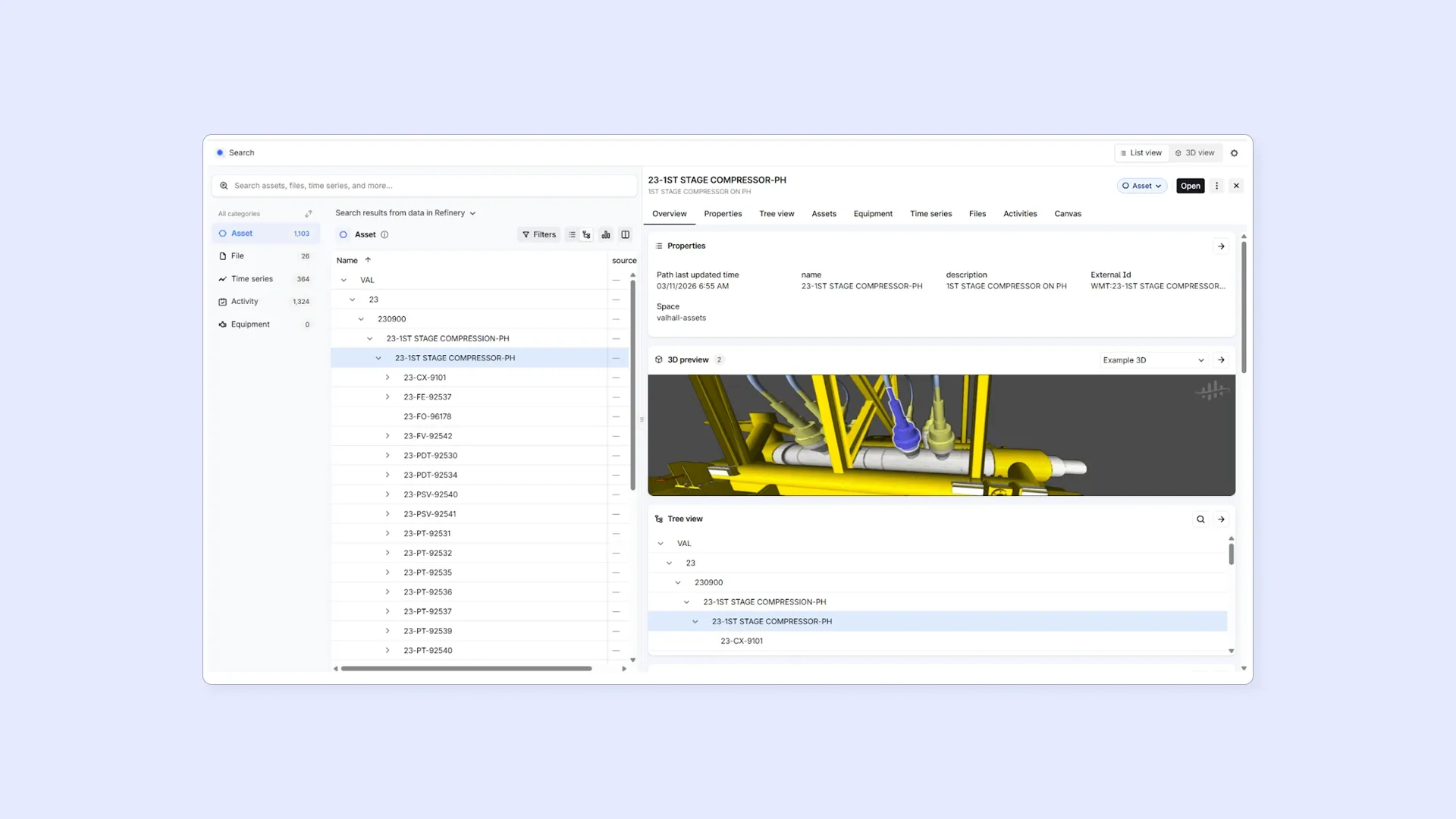
2. Hierarchy Navigation: Providing a logical drill-down from a unit level to a specific sub-component. In this case, a reliability engineer receives a notification that a specific piece of equipment is in bad health. The engineer wants to verify that every sensor contributing to this alert has been recently calibrated and that it is not a false positive. The reliability engineer can identify the correct asset without knowing the exact name, and then navigate the asset hierarchy to inspect condition of all associated transmitters.
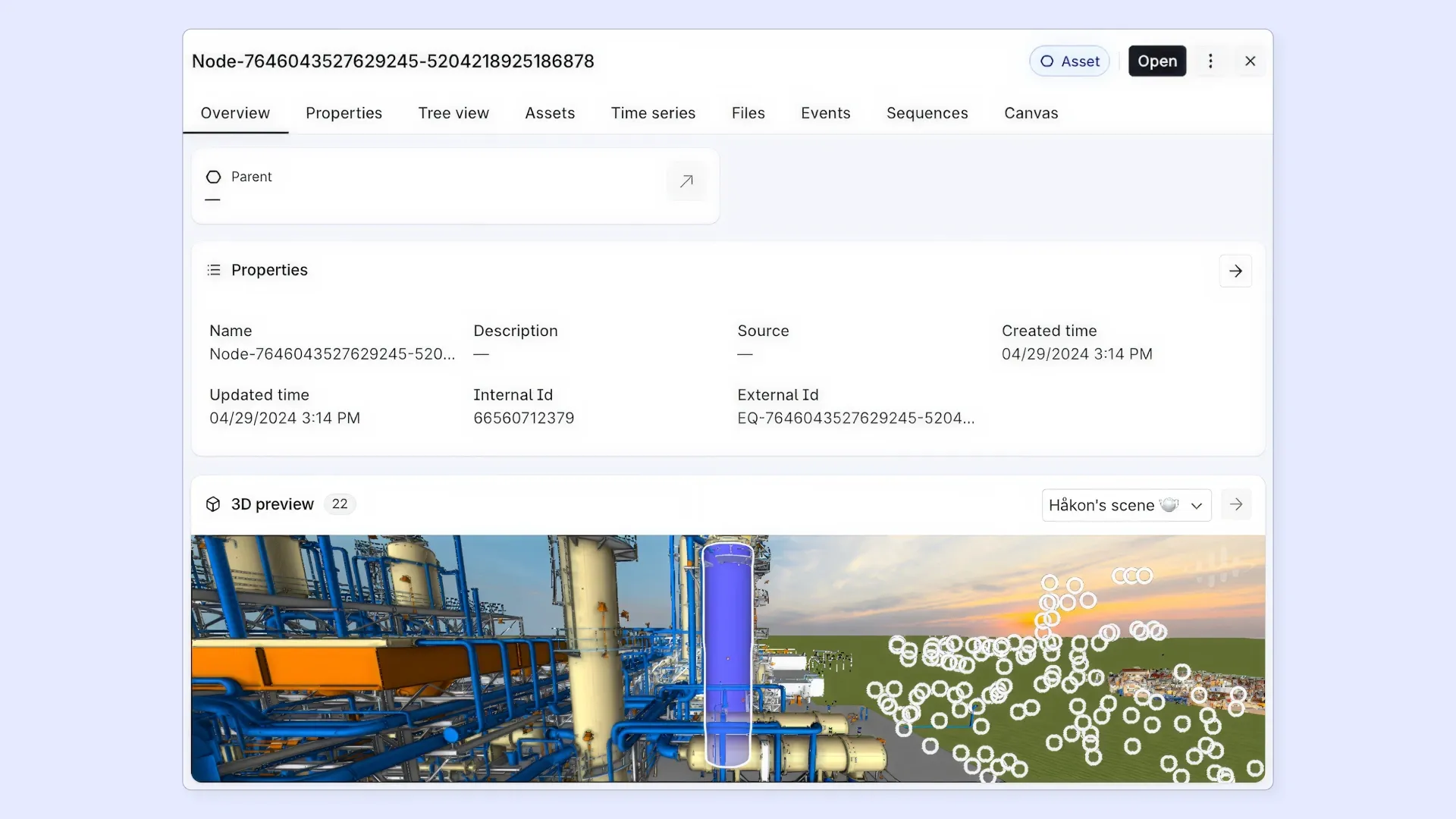
3. 3D Exploration: Identify a specific asset and navigate a contextualized view of CAD drawings and point clouds. Before a planned shutdown, a maintenance planner prepares a work package and needs to verify available spare parts, resources to do the work, scaffolding requirements, and whether there are any other open work orders that can also be scheduled. This search starts with a unique work package and uses associated 3D models and point clouds to visually identify any safety risks, confirm scaffolding requirements, and verify that no major changes have been made to the process.
Cognite’s precision search cuts through noisy industrial data by using smart parsing and flexible matching to instantly find the exact asset or work order. Once that specific starting point is identified, users can navigate intuitively using 3D models, P&ID tracing, or asset hierarchies. This combination transforms search from a simple lookup into a powerful tool for complex workflows.
The Foundation to turn Search into insights
Ultimately, the choice between exploration and precision search is determined by the problem. The fastest path to action requires the right search mode that matches the user’s intent in the moment.
Cognite uniquely delivers this range of search capabilities by unifying fragmented IT, OT, and engineering data into a trusted Industrial Knowledge Graph. By breaking down legacy silos and contextualizing unstructured documents, drawings, and events with live operational data, users and AI agents have a trusted source of truth for industrial information. This foundation ensures that whether industrial users are conducting a root cause analysis with an AI agent or navigating a 3D model to build a work plan, they are driving the actionable insights required for the high-stakes reality of industrial operations.
Ready to see what this means for your operations? Book a meeting with our team.