

Maruzen Petrochemical Co., Ltd. (Maruzen Petrochemical) is a chemical manufacturer established in 1959 when the petrochemical division of Maruzen Oil spun off as an independent entity. The company supports Japanese industry through the production of basic chemicals—centered on its ethylene plant—and specialty chemicals requiring advanced technology. The company positions digital transformation (DX) as its most critical strategy for evolving into a “safety-first company” and has introduced “Cognite Data Fusion (CDF)” at its Chiba Plant as the core foundation of this initiative. We spoke with Mr. Taisuke Horikoshi, Manager of the Equipment Diagnostics Section in the Equipment Management Department at the Chiba Plant, who leads the project, and Mr. Kento Kobayashi of the same section, about the transformation of maintenance operations driven by data integration through CDF.
Getting out of the “siloed” state of scattered data
Maruzen Petrochemical operates two plants in Japan, located in Chiba and Yokkaichi. At the Chiba Plant, the company’s main facility, decades of accumulated maintenance expertise remained fragmented across paper documents, separate databases, and the experience of veteran employees. Eliminating these data "silos" became a strategic priority to address critical bottlenecks in operational efficiency.
Specifically, the cost of searching for data was a major issue. Critical information—such as operational data, drawings, server logs, and maintenance histories—was scattered across various systems, and it was not uncommon to spend more than half a day simply collecting and organizing information when a problem arose. Second, the company faced significant hurdles in knowledge transfer and the reliance on individualized expertise. In particular, measures to address deterioration and damage specific to individual pieces of equipment within the plant required highly specialized judgment, but since this knowledge was not systematized, the company relied heavily on the experience of veteran employees. Furthermore, with an eye toward the future decline in the working-age population, it was urgent to create a system that would reduce the workload per employee and shift resources toward higher-value-added tasks.
Background from the Start of Implementation Considerations to the Decision-Making Process
When selecting a data platform to consolidate data scattered across multiple systems, the company prioritized finding a platform that was “easy for frontline staff to use.” Behind this decision lay high expectations for “contextualization” capabilities—the ability to tag and link data from different sources—rather than simply storing data. Furthermore, since the company did not have a dedicated DX department, the evaluation was conducted by a team comprising members of the Facilities Management Department, who were closely tied to frontline operations and participated in a part-time capacity. Because the members themselves—who were intimately familiar with the challenges faced on the front lines—were directly involved in the selection process, Cognite was chosen as the platform best suited for practical use.
Solution Implementation and Usage Status
The project was launched in 2021, and following a proof of concept (PoC) for data connectivity, full-scale development began in 2023. Thanks to agile development, the system was launched in just four months. The company is now utilizing Cognite Data Fusion as a comprehensive data integration platform for its various operational needs.
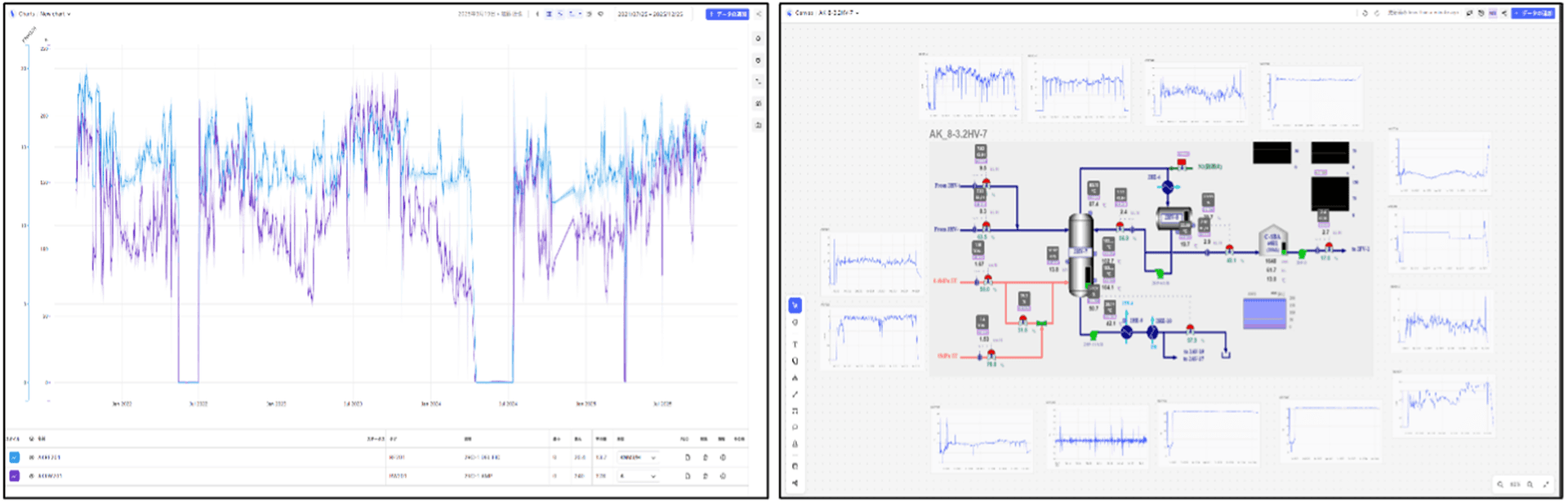
A prime example is the “Equipment Information Dashboard.” By simply selecting a specific piece of equipment on a PC, users can instantly view its scheduled maintenance cycles, inspection history, and even 360-degree panoramic photos, allowing them to access information that closely mirrors the actual condition of the equipment without leaving the office. The system also provides visualizations that graph the wall thickness reduction of complex piping systems to identify trends and correlations in corrosion issues, and facilitates on-site coordination for scheduled maintenance inspections.
The company has also begun to pursue field-driven app development. Technical staff leveraged generative AI to develop an in-house “Tower Load Visualization App” in just two hours. Whereas system modifications previously took several weeks, the company has now established an environment where such changes can be implemented immediately based on on-site decisions.
Results of Cognite Data Fusion Implementation
In quantitative terms, for certain key pieces of equipment where CDF was implemented early on, we were able to reduce the annual workload by approximately 1,000 hours for tasks such as data analysis, drawing verification, and report preparation carried out by the Equipment Diagnostics Section and the Engineering and Operations departments. Furthermore, in terms of failure tree analysis (FTA), the ability to instantly search for past similar cases has dramatically improved the accuracy and speed of decision-making. We expect these cost-saving effects to increase further as we expand the system to other equipment in the future.
Qualitatively, significant progress has been made in systematizing the transfer of technical knowledge. By digitally linking past inspection records, repair reports, and 360-degree panoramic photos for each piece of equipment, an environment has been established where junior employees can proactively seek out and learn from information. Furthermore, the ability to build simple apps on-site without relying on external contractors has not only reduced costs but is also gradually fostering a culture of innovation within the field.
Future Outlook
Based on the results of its initiatives to date, Maruzen Petrochemical views CDF as the “keystone of digital transformation” and is planning further expansion.
“We plan to expand the implementation to multiple facilities, starting with our main ethylene plant, by fiscal year 2027. On the technical front, we are exploring the advanced use of generative AI; by training the system on vast amounts of historical inspection text data, we aim to automate equipment diagnostics and implement advanced recommendation features.” (Daisuke Horikoshi)
“Going forward, we aim to accelerate the optimization of overall plant operations through further data standardization and expanded integration with component analysis and procurement data.” (Katsuyoshi Kobayashi)
The company’s approach of making full use of data through on-site initiatives will continue to evolve as a model case for DX in the process industry.