
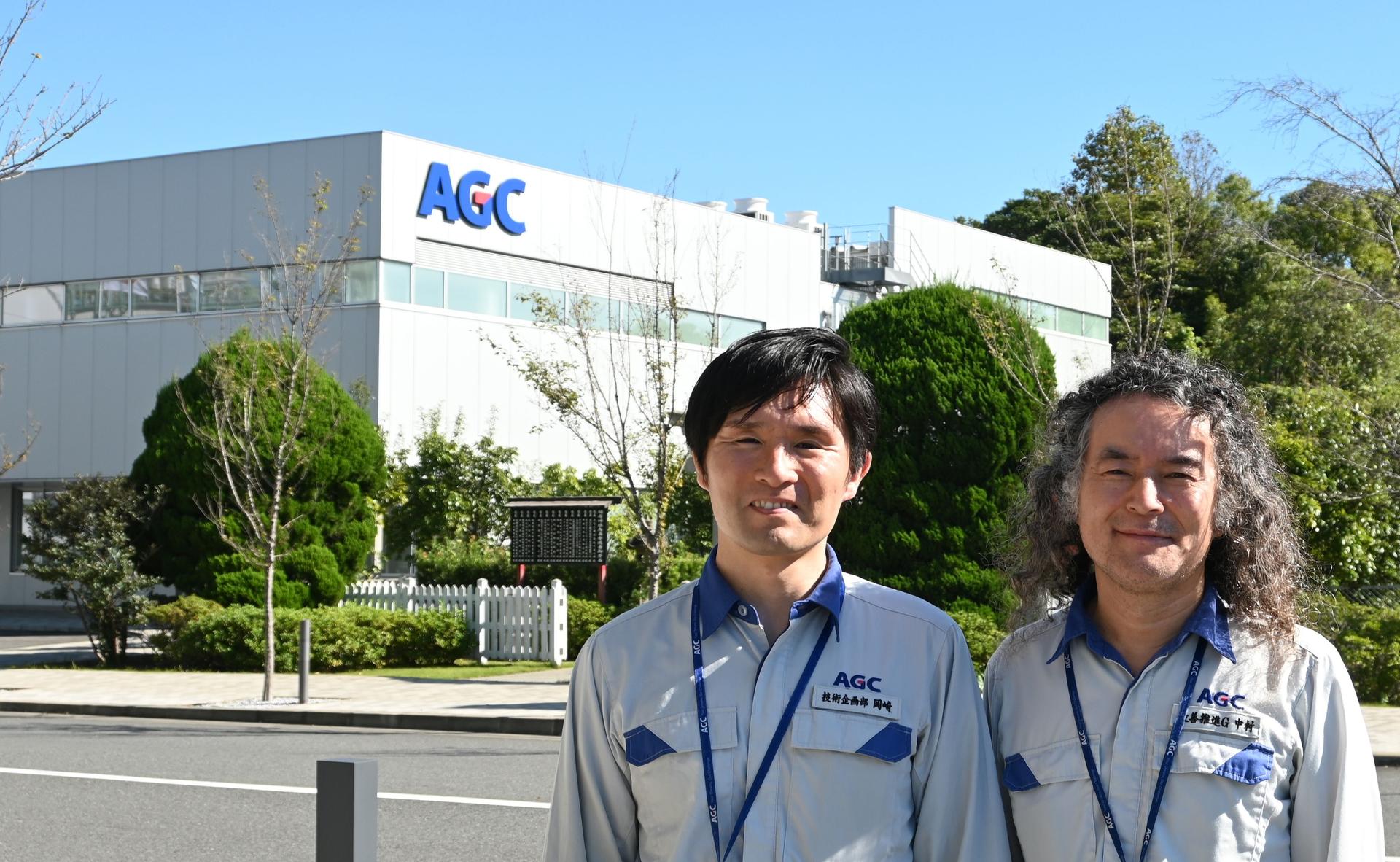
AGC is a comprehensive materials manufacturer that holds the global top market share across a wide range of products. Founded in 1907 with the production of flat glass, AGC has continually provided materials and solutions needed by society in response to changing times. Today, AGC operates in more than 30 countries and regions worldwide, developing businesses across a broad range of fields, including Architectural Glass, Automotive, Electronics, Chemicals, and Life Science.
In its chemical business in particular, AGC boasts a leading market share in Southeast Asia for polyvinyl chloride (PVC) and caustic soda, while holding the world's No.1 market share in fluororesin (ETFE resin) used in electrical wiring.
AGC has positioned "Value Creation DX" as a core strategy in its medium-term management plan. Launched in stages starting in 2017, the company's digital transformation journey has evolved from foundational building and innovation to its current phase of "Institutionalization and Stabilization." Within the Chemicals Company, site-level reforms utilizing digital technologies are underway, aiming for "data-driven decision-making" and "operational efficiency" across the entire value chain.
Challenges Prior to Cognite Implementation
Behind these reforms lies the declining working population—an issue faced by Japanese manufacturing as a whole. To prepare for future labor shortages, AGC's Chemicals Company sought to establish a flexible organizational structure (personnel reallocation / redeployment) where engineers are not confined to specific plants, but can cross-functionally support projects and improvement activities across the entire factory.
However, one of the main obstacles was the burden of working hours on site engineers In a survey conducted at the Kashima Plant in 2023, "document creation" was cited as the single greatest workload burden for engineers. Follow-up interviews revealed that the vast majority of the time spent on creating documents was actually consumed by searching for and organizing the necessary data.
At the time, "data siloing"—where information and data were stored independently across isolated systems—was a critical issue inside the plant. For instance, PIMS (Process Information Management System) recorded real-time operational data such as plant temperature and pressure; CMMS (Computerized Maintenance Management System) managed equipment repair histories and piping and instrumentation diagrams (P&ID); and systems like Box and SharePoint stored files such as technical documents and trouble reports—all operating independently.
Consequently, when equipment trouble occurred, engineers had to follow an extremely tedious process: checking drawings in CMMS, extracting and processing operational data in PIMS, reviewing past repair histories back in CMMS, and searching for related documentation in SharePoint. As a result, engineers had to spend a significant amount of time merely searching for and gathering data, making it difficult to allocate sufficient time to essential tasks such as root-cause analysis and developing troubleshooting solutions.
The Solution
To break through this data siloing, AGC implemented Cognite Data Fusion (CDF), an industrial data operations platform provided by Cognite. CDF was selected primarily for three reasons:
1. High Automated contextualization capabilities: Proprietary AI automatically links approximately 80% of data across different systems, significantly reducing implementation preparation work.
2. Generative AI capabilities and future scalability: Equipped with advanced interactive AI capabilities (Atlas AI), offering strong potential for future applications.
3. Track record in the oil and chemical industries: Proven adoption across industry peers, with architecture optimized for plant data.
From October 2025, a one-year Proof of Concept (PoC) was conducted in the manufacturing section of the Kashima Plant. Five data types were integrated: operational data (PIMS), maintenance data (CMMS), technical documents/delivery specifications/accident and trouble reports (Box), as well as 3D point cloud data for 3D site verification, and SharePoint, which was in high demand internally.
With the introduction of CDF, roughly 80% of data contextualization was automated, enabling the team to build the foundation in a short period without getting bogged down in manual work. Engineers can now instantly pull up drawings, operational data, repair histories, related documents, and 3D models simply by entering an equipment number (asset tag) on screen.
During effect verification, more than half of the target users accessed the platform "at least once a week," and about one-third of engineers used it "at least once every two days." Furthermore, over half responded that it "helps with work at plants where I have no prior experience," and two-thirds gave high marks stating they "want to continue using it," leading to the official decision for company-wide deployment.
Use Cases
With the introduction of CDF, daily operations on-site transformed in the following ways:
1. Faster Troubleshooting via Instant Asset Tag Searches: When trouble occurs, engineers simply type the equipment number into the CDF search bar to display all related drawings, real-time data, past repair histories, accident reports, and 3D models in one place. With information gathering taking significantly less time than before, engineers can immediately begin root-cause investigations and evaluate countermeasures.
2. Simplified Graphing and Sharing via Time-Series Analysis Tool "Charts": During trouble analysis, engineers can now intuitively display trends for calculated tags created using multiple sensor datasets right on screen. Created graphs can be shared with other team members via a single URL, drastically accelerating situational awareness and hypothesis testing.
3. Development of a Generative AI-Integrated "Specific Consumption Analysis App": Using generative AI, an app that analyzes specific consumption (the amount of raw materials and energy required to produce 1 kg of product) against production volumes was developed in just over a week. Clicking on a "day when specific consumption deteriorated" on the app interface automatically picks up trouble records and work logs from that date. Furthermore, asking the on-screen generative AI (Atlas AI) in plain text—"Tell me the day with the worst specific consumption during this period and the reason why"—prompts the AI to analyze various datasets and provide a concrete answer: "It was February 8. The cause was a temporary dip in production volume due to an emergency shutdown incident." The AI interprets both quantitative data and textual records, delivering powerful support for root-cause identification.
Future Outlook
Following the success at the Kashima Plant, AGC's Chemicals Company is advancing a phased rollout. In "Phase 1," starting in October 2026, efforts are focused on the following three areas:
1. In-house capability & talent development: Cultivating internal engineers to handle system configuration and management independently without relying entirely on external partners.
2. Expanding data sources: Connecting even more internal databases to CDF to broaden the scope of automated contextualization.
3. Addressing site needs: Incorporating feedback from the field to further advance the utilization of generative AI and custom applications.
Roughly two years after the start of Phase 1, the company plans to transition to "Phase 2," sequentially expanding the system to major domestic production bases, starting with the Chiba Plant.
Through the implementation of Cognite, AGC transforms operational know-how and data into organizational strengths, establishing a next-generation engineering structure capable of operating cross-functionally across plants. Through these efforts, AGC aims to build a safe, secure, and sustainable operational framework even in an era of population decline, while further strengthening its competitiveness in the global market.