
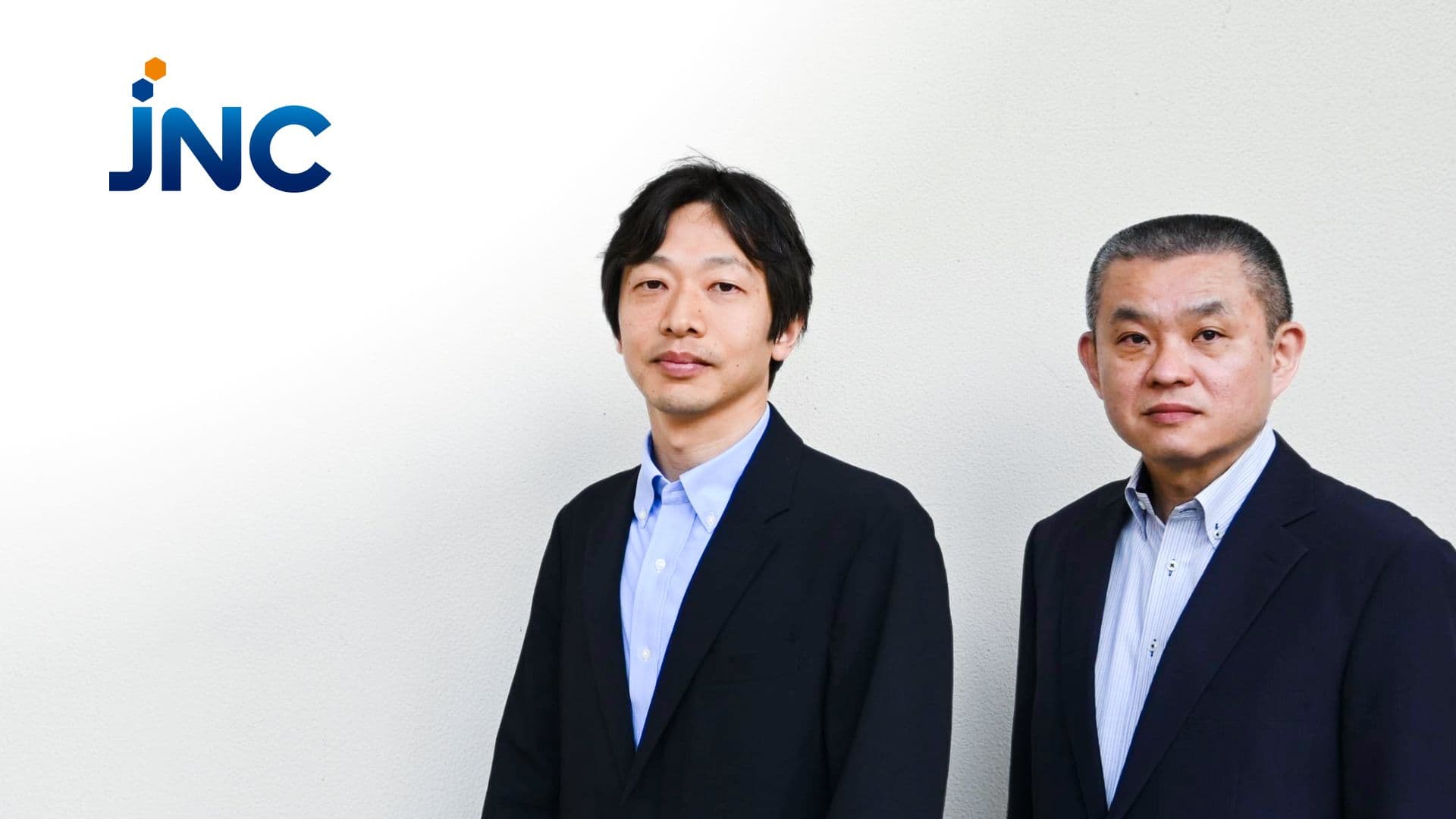
Since its founding in 1906, JNC Corporation has been operating globally as a comprehensive chemical manufacturer with a 120-year history. Its business centers on four key segments: Performance Materials, Green Energy & Engineering, Agri-Life Innovation, and Chemical Materials. A distinctive feature of JNC is its commitment to a sustainable society.
At the Minamata Works, the company manufactures products using electricity generated by its own hydroelectric power plants and supplies surplus power to the city of Minamata, Japan.
Challenges Before Implementing Cognite Data Fusion
As JNC promoted Digital Transformation (DX), one of the major challenges it faced was the "siloing" of data at manufacturing sites.While vast amounts of information existed—including drawing data, time-series data from sensors, quality control data, and equipment maintenance records—they were managed separately across individual systems or Excel files.
As a result, whenever data was needed for analysis or simulation, personnel had to download it from various systems and manually process or aggregate it in Excel. This repetitive data collection and preprocessing across different departments led to operational inefficiencies and dependency on specific individuals, hindering rapid situational awareness and decision-making.
Despite the desire to leverage data, the preparation work consumed excessive time and effort. Establishing a platform that could integrate data and enable analysis based on shared facts became an urgent priority.
Background: From Evaluation to Decision-Making
JNC selected Cognite Data Fusion because of its strength in "contextualizing" industrial data—automatically linking disparate data points. Cognite Data Fusion can ingest complex industrial data (IT, OT, and engineering data) from primary source systems and automatically associate and integrate equipment tags, time-series data, P&IDs, and drawings.
JNC determined that Cognite Data Fusion provided an environment where users could intuitively understand which data was linked to specific equipment or events. The goal was not just data visualization, but the establishment of a highly reliable data foundation that would allow site engineers to begin analysis immediately.
Furthermore, the openness of Cognite API was a key factor. JNC valued its extensibility, including seamless integration with existing tools like Excel and Python, as well as its readiness for integration with Generative AI. This flexibility and scalability made Cognite Data Fusion the choice for a long-term DX foundation.
Small-Start Implementation and Expanding Utilization
Following the decision to adopt Cognite, JNC began a project in collaboration with Cognite, focusing on a phased rollout. By prioritizing use cases directly linked to operational challenges on the ground, the company has proceeded with a "small-start" approach.
One representative initiative is the creation of a mechanism to retrieve Cognite data directly into Excel. Users can now reference time-series data simply by entering a function in Excel, without needing to be conscious of the Cognite API. This has significantly lowered the barrier to data utilization, creating an environment where data is handled naturally in daily operations.
In the hydroelectric power department, a dashboard was built on Cognite Data Fusion to visualize power generation status in real time. Previously, status updates were shared internally at fixed intervals; now, the information is available instantly, leading to faster decision-making.
Furthermore, in batch plants, JNC developed custom applications that integrates batch records with time-series data on Cognite Data Fusion. This allows for rapid analysis of the relationship between quality and operating conditions for specific lots—a process that previously required significant manual labor.
JNC is also developing cost management dashboards to enable related departments to discuss budget vs. actuals based on common data.
Through these efforts, JNC is utilizing Cognite Data Fusion as a practical platform that supports onsite decision-making and operational improvement.
Insights from PoC and Continued Use
The implementation of Cognite Data Fusion has significantly reduced the burden of data preparation. With rapid access to necessary data, site engineers can now devote more time to analyzing and investigating phenomena rather than preparing data.
Additionally, by combining the Cognite API with Generative AI, JNC is developing an environment where applications tailored to field needs can be created and improved quickly. For example, initiatives led by the DX promotion team—working closely with operational sites—include mechanisms such as triggering notifications to relevant stakeholders when drawings are updated. This sense of speedily turning on-site ideas into reality has boosted motivation and awareness regarding DX across the organization.
Future Outlook
JNC’s DX journey began with a PoC at the Minamata Works and is currently in a phase of verifying effectiveness and applicability. Moving forward, JNC plans to expand the scope to other facilities and departments based on these results.
Regarding functionality, JNC aims to move beyond visualization and analysis toward automation and optimization using AI. Specifically, the company plans to implement machine learning models on the data platform for quality prediction and predictive maintenance. JNC will continue to incorporate feedback and new ideas from operations, collaborating with Cognite to further enhance the platform.
JNC intends to evolve the data platform centered on Cognite Data Fusion into a common decision-making foundation for all divisions, including business and research. By steadily advancing data accumulation, contextualization, and the integration of Generative AI, JNC will evolve its 120-year-old manufacturing sites into advanced, sustainable, next-generation plants.