
Tosoh Corporation, driven by its corporate message "The Chemistry of Innovation,” operates its business centered around two major manufacturing hubs: the Nanyo Complex in Yamaguchi Prefecture and the Yokkaichi Complex in Mie Prefecture. As a comprehensive chemical manufacturer boasting one of Japan's largest integrated vinyl chloride/urethane production chains and ethylene crackers, Tosoh leverages its robust business foundation and advanced technological capabilities to ensure a stable supply of chemical products and contribute to a prosperous, sustainable society.
Background of Cognite Data Fusion Implementation
From the late 2000s to the early 2010s, Tosoh experienced a period of mass retirement among the baby boomer generation. During this transitional phase, the company actively recruited younger workers, successfully securing the talent needed to sustain future plant operations. However, as time passed and the generational shift progressed, it became increasingly apparent that the next-generation workforce on the shop floor was facing new challenges: aging equipment, future labor shortages, and a vague anxiety regarding long-term, stable operations.
To address these concerns from the manufacturing frontline and materialize a "workplace where the next generation can work with peace of mind," Tosoh first analyzed the root causes of past incidents. The analysis revealed a stark reality: approximately 45% of troubles caused by human factors stemmed from gaps in knowledge and experience—specifically, instances where operators either "did not know" past findings or "knew them but could not respond correctly."
To dig deeper into the core of these issues based on these findings, Tosoh conducted a large-scale survey targeting all 33 job categories across all manufacturing departments at both the Nanyo and Yokkaichi Complexes. Young operators in their early 30s, who represent the future of the production sites, unanimously voiced that "the difference between themselves and veterans lies in the ability to respond to troubles." The survey highlighted that about half of the workplaces felt a lack of knowledge regarding processes and equipment. Concurrently, a survey of manufacturing department managers revealed that approximately 80% of respondents wanted a system that would allow them to view necessary information on the spot. This reflected an urgent need to reduce excessive reliance on specific individuals and to detect abnormalities at an early, minor stage.
Through this series of transitions and investigations, Tosoh concluded that protecting the frontline's peace of mind required a mechanism that reduces the time young workers waste searching for past incidents and related knowledge, allowing them to quickly access required information in a "chain-link" (seamlessly interconnected) manner. This approach was seen as vital to reducing human-factor incidents. Consequently, Tosoh decided to implement a data platform capable of connecting and presenting information in this interconnected fashion.
The Cognite Data Fusion Implementation Project
Tosoh selected Cognite from among six competing companies to be its partner in solving these frontline challenges. The deciding factors for choosing Cognite were the high performance of its AI and OCR-driven automated text conversion capabilities, as well as its flexible scalability for easy, real-time integration with external systems. A mechanism that allowed quick access to necessary data was exactly the technology Tosoh was looking for.
The actual implementation project moved forward on an exceptionally fast-tracked schedule. Following the official decision to adopt Cognite Data Fusion in April 2025, the project was launched simultaneously at both the Yokkaichi and Nanyo Complexes in June 2025. Tosoh formed a cross-functional, hybrid DX team involving headquarters, manufacturing, maintenance, IT departments, vendors, and even frontline youth, fostering active information exchange through weekly regular meetings. As a result, system implementation at both locations was completed in December 2025—a remarkably short span of just six months.
Furthermore, user skill transfer training to ensure a smooth transition to operational use on the shop floor began immediately upon completion of the implementation, paving a clear path for full-scale rollout starting in 2026.
This rapid project execution successfully prevented siloed optimization at individual sites, allowing Tosoh to establish a company-wide standard model at an early stage. This achieved the centralized management of over 900,000 pieces of previously scattered data.
Cognite Data Fusion Use Cases
The utilization of Cognite Data Fusion at Tosoh is already yielding tangible results in frontline decision-making and operational efficiency. By seamlessly linking vast amounts of previously scattered data, the time lost by operators searching for or moving to access information is being drastically reduced.
- Use Case 1: Streamlining Communication via Canvas
Previously, gathering information via email or phone before morning meetings and hand-writing updates on whiteboards required significant time and labor. Now, visual data is consolidated in a single digital whiteboard environment, allowing preparation to be completed in advance and enabling rapid discussion during morning meetings.
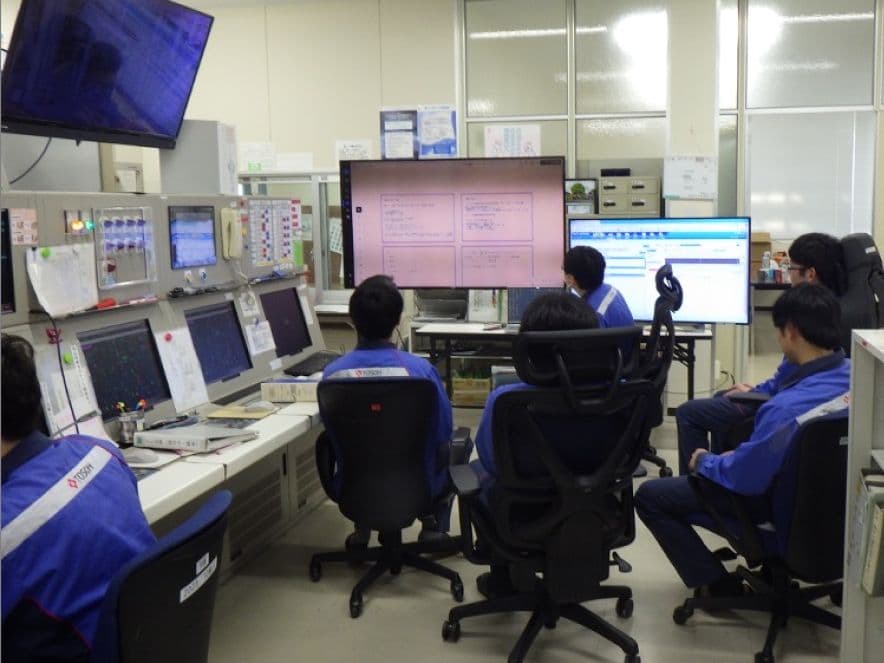
- Use Case 2: Real-Time Remote Monitoring via DCS Replication
By recreating DCS (Distributed Control System) screens within Canvas, real-time remote monitoring has become a reality. Previously, walking from the office to the control room took 5 to 10 minutes, making travel for troubleshooting a physical burden. The system has bridged this physical distance. Operators can now perform real-time remote monitoring right from the office using familiar DCS interface designs, dramatically accelerating initial response times when issues arise. - Use Case 3: Visualizing Veteran Skills via Charts
In the past, extracting historical trouble data and converting it into graphs was a labor-intensive process. Now, time-series data—such as the gradient during the startup of specific reactions—can be locked, saved, and shared. This provides young operators with visual, concrete decision-making criteria, offering invaluable learning opportunities.
Future Outlook
A few months into operation, Tosoh is further enhancing on-site usability by reflecting feedback and requests from the frontline. Specifically, the company is leveraging Cognite’s Atlas AI to automate data cleansing. Additionally, they are developing initiatives that use shift-handover logs as a starting point to automatically surface similar past trouble logs in a chain-link fashion, prompting operators to notice early signs of potential issues.
Furthermore, to ensure deep proficiency with Cognite Data Fusion across the entire organization, Tosoh plans to host regular internal user group meetings and broadly invite applications from departments wishing to adopt the platform. By encouraging voluntary, bottom-up participation and prioritizing deployment in highly motivated departments, Tosoh aims to build highly effective utilization models throughout the company.
Ultimately, Tosoh aims to implement the system across all departments, embedding frontline peace of mind into the corporate culture and establishing a sustainable manufacturing framework as it steps forward into a workplace where the next generation can work with absolute confidence.